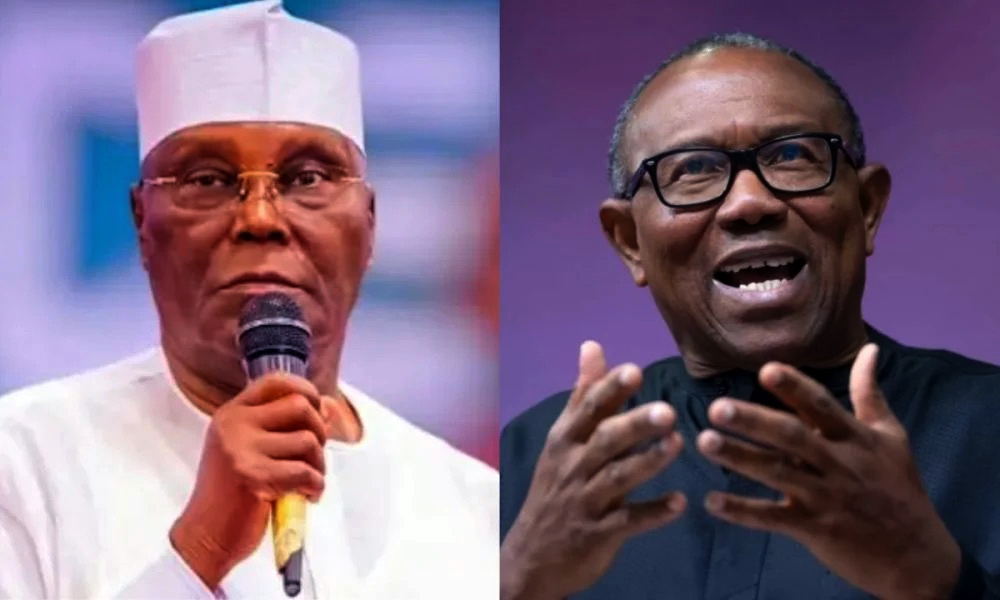
Photo: Atiku and Obi
By Daniel Kanu
Opposition risks repeat of 2023 split as leading contenders cling to presidential ambitions.
The much-anticipated plan by Nigeria’s opposition parties to unite behind a single presidential candidate against President Bola Ahmed Tinubu in the 2027 election appears increasingly headed for collapse, as leading contenders remain unwilling to sacrifice their ambitions for a common ticket.
At the centre of the growing disagreement are former Vice President Atiku Abubakar and the presidential candidate of the Nigeria Democratic Congress (NDC), Peter Obi, whose failure to agree on who should lead a united opposition has cast fresh doubts on the viability of the coalition.
Although the opposition coalition was initially hailed as the most credible attempt since the 2023 presidential election to consolidate anti-All Progressives Congress (APC) forces, the emerging cracks suggest that the opposition may again enter the presidential contest with multiple candidates.
Governor Seyi Makinde of Oyo State, African Action Congress (AAC) candidate Omoyele Sowore, Social Democratic Party (SDP) candidate Adewole Adebayo and other opposition presidential contenders have equally maintained their individual ambitions, further complicating efforts to produce a single challenger to Tinubu.
The development has renewed fears within opposition circles that the division that characterised the 2023 presidential election could be repeated in 2027, potentially giving the incumbent another advantage.
The concern became more pronounced following the publication by the Independent National Electoral Commission (INEC) of its final list of presidential candidates for the 2027 election.
Rather than the relatively small field envisaged by advocates of opposition unity, the final list confirms a crowded presidential contest, with several candidates preparing to campaign separately against Tinubu.
The current situation is a sharp departure from the optimism that greeted the opposition coalition earlier in the year.
Atiku, Obi and several other opposition leaders had appeared together as efforts gathered momentum around the African Democratic Congress (ADC), creating the impression that the major opposition forces might eventually agree on a single presidential candidate.
The coalition was widely seen as an attempt to correct the fragmentation that weakened the opposition in 2023.
However, the alliance subsequently suffered a major setback when Obi left the ADC in May and later emerged as the presidential candidate of the NDC.
Atiku, meanwhile, remained in the ADC and secured its presidential ticket.
With the two leading opposition figures now backed by separate political parties and campaign structures, the possibility of one stepping aside for the other has become increasingly remote.
Makinde has also continued to pursue his presidential ambition on the platform of the Allied Peoples Movement (APM), adding another major contender to an already crowded opposition field.
The widening gulf among the opposition leaders was further exposed on August 31 when six opposition parties met at the Shehu Musa Yar’Adua Centre in Abuja for a summit organised by the G-100, a political coalition led by former APC national vice-chairman, Salihu Lukman.
The summit proposed a Government of National Competence based on a single four-year transitional term.
It also established a Central Leadership Committee, Publicity and Communication Committee and Legal Committee, while agreeing to set up five working groups ahead of a second summit aimed at advancing negotiations on opposition cooperation.
However, Atiku, Obi and Makinde were conspicuously absent from the gathering.
Their absence immediately raised questions about whether the broader coalition could achieve its principal objective without the participation and eventual agreement of the major presidential contenders.
For critics, the absence demonstrated the fundamental problem confronting the opposition: while there is broad agreement among several groups that Tinubu should be defeated, there is no agreement on who should carry the opposition’s presidential banner.
Former presidential aide Reno Omokri subsequently criticised the inability of the opposition leaders to reach a compromise, arguing that the ambitions of the leading contenders could make it difficult for them to accept a subordinate position.
The APC has also seized on the divisions.
The party’s Lagos State spokesman, Seye Oladejo, described the opposition coalition as an assembly of serial presidential aspirants who were unwilling to subordinate their individual ambitions to a collective objective.
He argued that the coalition lacked the ideological and organisational cohesion required to defeat an incumbent president.
The issue of who should lead the opposition became even more apparent when Obi was recently asked whether he would accept the vice-presidential slot in an Atiku-led arrangement.
Obi rejected the suggestion, maintaining that he was already the presidential candidate of his party while Atiku was the candidate of another political party.
He argued that any possible alliance would have to be negotiated between the parties rather than reduced to an arrangement between two individuals.
The response effectively reinforced the impression that Obi is not prepared to abandon his presidential ticket for Atiku who many commentators say should have buried his ambition bearing in mind this is a slot for the South, given the North/South rotation agreement.
But Atiku, has given no indication that he intends to surrender the ADC presidential ticket to Obi.
The question therefore remains unanswered: Who steps down for whom?
That question has become the biggest obstacle to the proposed opposition coalition.
Efforts to create a smaller opposition alliance have equally encountered difficulties.
A separate arrangement involving Accord, the AAC and the SDP has yet to produce a consensus presidential candidate.
Sowore has continued to advocate a political coalition based on fundamental change and the interests of Nigerians rather than an alliance formed principally to defeat Tinubu.
Adebayo has similarly shown little inclination to abandon his presidential ambition simply to support another opposition candidate.
The situation has been further complicated by divisions within some of the smaller opposition parties.
Accord’s national leadership, for instance, has publicly expressed support for Tinubu, illustrating the difficulties involved in constructing a common anti-APC platform from parties with different political calculations.
But not all opposition figures have insisted on retaining their tickets.
Former Cross River State governor and Peoples Redemption Party (PRP) presidential candidate, Donald Duke, has indicated that he would be willing to step aside for any candidate genuinely chosen by a united opposition.
Duke has warned that opposition fragmentation could ultimately return Tinubu to the Presidency, even if the President fails to win an outright majority of the popular vote.
However, his willingness to sacrifice his ambition has had limited impact because he seems not to command the same national political structure and electoral following as Atiku and Obi.
The fear of another divided opposition is rooted in the outcome of the 2023 presidential election.
Tinubu of the APC won the election with 8,794,726 votes, representing approximately 36.6 per cent of the valid votes cast.
Atiku, who contested on the platform of the Peoples Democratic Party (PDP), polled 6,984,520 votes, while Obi, then the presidential candidate of the Labour Party, secured 6,101,533 votes.
The combined figure for Atiku and Obi was more than 13 million votes.
While the votes cannot automatically be added together because voters do not necessarily transfer their support from one candidate to another, the figures have remained central to arguments that opposition fragmentation helped Tinubu emerge victorious.
It was partly against this background that efforts to build a broad opposition coalition gained momentum after the 2023 election.
The objective was to prevent a repeat of a contest in which multiple opposition candidates divided the anti-incumbency vote.
But as the 2027 election approaches, the same problem appears to be returning.
Expectedly, the Presidency has dismissed the opposition coalition as a serious threat to Tinubu’s re-election.
Special Adviser to the President on Information and Strategy, Bayo Onanuga, has argued that even a joint Atiku-Obi arrangement would not defeat a Tinubu-Shettima ticket.
The position reflects the confidence of the ruling APC that the opposition remains too divided to constitute a formidable electoral challenge.
For opposition strategists, however, the major problem is no longer whether the parties can agree in principle on the need for a united front, but whether their presidential contenders can make the personal and political sacrifices required to achieve it.
With Atiku and Obi now holding separate presidential tickets, Makinde pursuing his own ambition and Sowore, Adebayo and other contenders unwilling to surrender their bids, the window for producing a single opposition candidate is narrowing.
Any last-minute arrangement would require candidates to abandon established campaign structures, negotiate party interests, settle questions over leadership and agree on a common presidential and vice-presidential ticket.
It would also require the various blocs to resolve deep-seated disagreements over ideology, power-sharing, zoning, party structures and the composition of a possible government.
The opposition is therefore at a political crossroads.
On one side is the argument that only a united opposition can mount a serious challenge to an incumbent with the machinery and resources of the Federal Government behind him.
On the other is the determination of individual candidates to pursue their presidential ambitions, regardless of whether their candidacies divide the opposition vote.
Unless the major contenders can overcome their differences and agree on a credible consensus arrangement, the 2027 presidential election could once again produce a fragmented opposition field.
For Tinubu and the APC, such fragmentation could prove politically advantageous.
For Atiku, Obi and the other opposition candidates, however, the lesson of 2023 remains stark: a divided opposition may win millions of votes collectively, but lose the Presidency individually.
With the election approaching and campaign structures already taking shape, the opposition has limited time to resolve its most difficult question — whether the collective ambition of defeating the incumbent is strong enough to overcome the individual ambition of becoming President.
If no compromise emerges, the opposition may find itself fighting the 2027 presidential election on two fronts: against Tinubu and, perhaps more significantly, against itself.
What may be the game changer is that Nigerians have vowed to come out enmass to vote and to defend their vote given the prevailing hardship in the land. If this happens, it will be difficult for the ruling party APC, to rig.